
2.3 – On Gauging Angles

To practice drawing straight lines at various angles we’re going to employ a metaphor – a clock face.
2.2 – On Drawing Straight Lines

The ability we must work to develop is drawing lines that are straight and which actually go in the direction we intend. This is a manual skill that a…

2.1 – Introduction to Line

Line is the primary element of drawing. Any work of art, when reduced to its most fundamental level, may be regarded as an assemblage of shape and bou…

8.4 – Sphere: Value Study

As ever, it's wise to investigate the primary value relationships at play on the sphere before diving-in to the full light and shade development.

8.3 – Structuring the Sphere

The sphere may be circular in silhouette, but there are still some important factors to consider regarding our perspective and the direction of the li…

8.1 – Structure of a Sphere

The sphere is the only volume in our lineup where perspective has no influence on the outer silhouette – the shape of a sphere is circular, regardl…

6.6 – Modeling the Cube

With the structure and value relationships worked out in advance, we can now proceed to the careful description of the effect of the light.

6.3 – Structuring the Cube

As we set out to draw the cube, remember that our drawing procedure unfolds in two distinct stages: a primary linear stage in which we define the stru…

6.2 – On Linear Perspective

As we embark upon drawing the elemental forms, we are immediately met with a problem: where to start? Each of these forms is simple in its own way, an…

6.1 – The Logic of the Light

Strictly speaking, any visual experience is all about the light. In fact, we're not able to perceive with our eyes anything but light, and so in a rea…

7.6 – Modeling the Cylinder

With the linear and value study stages complete, we can now proceed to the full value development – and modeling the form – of the cylinder.

7.5 – Cylinder Value Study

There's a lot to consider in developing the values on any form. It always pays to do a small value study first – a kind of "research stage" to gath…

7.4 – Light Side vs. Shadow Side

Before we get started drawing, there’s one more thing to say about the cylinder. The light side of the cylinder embodies only half of it’s total v…

8.5 – Modeling the Sphere, Part 1

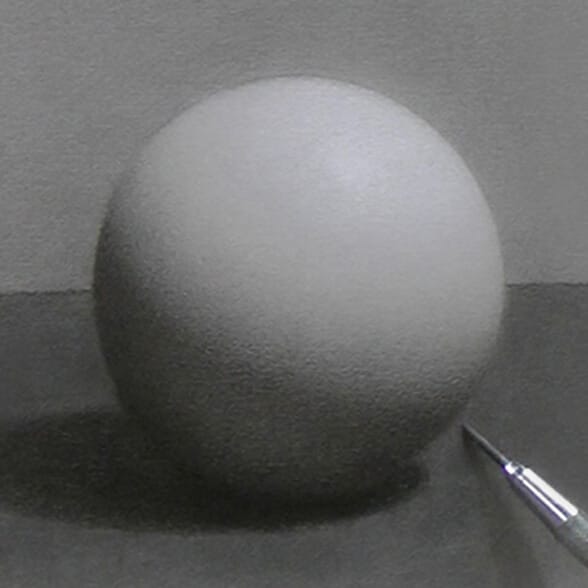
In this lesson we develop the light and shade on the sphere, paying particular attention to the shape of the shadow and light masses, attempting to "t…

7.3 – On “Turning the Form”

With the linear structure of the cylinder established its time to develop the effect the light. This being our first rounded object, we have a new cha…

7.1 – Introduction to the Cylinder

Since we began with the cube, a volume that has no surface curvature, it makes sense to proceed to the cylinder — a volume featuring what we call "…